Finding itisn't fixing it
StrikeSonic runs the loop from threat to verified outcome. Agents read your scanners, correlate to your estate, score the risk and draft the fix. A named person signs. Then a rescan proves it.
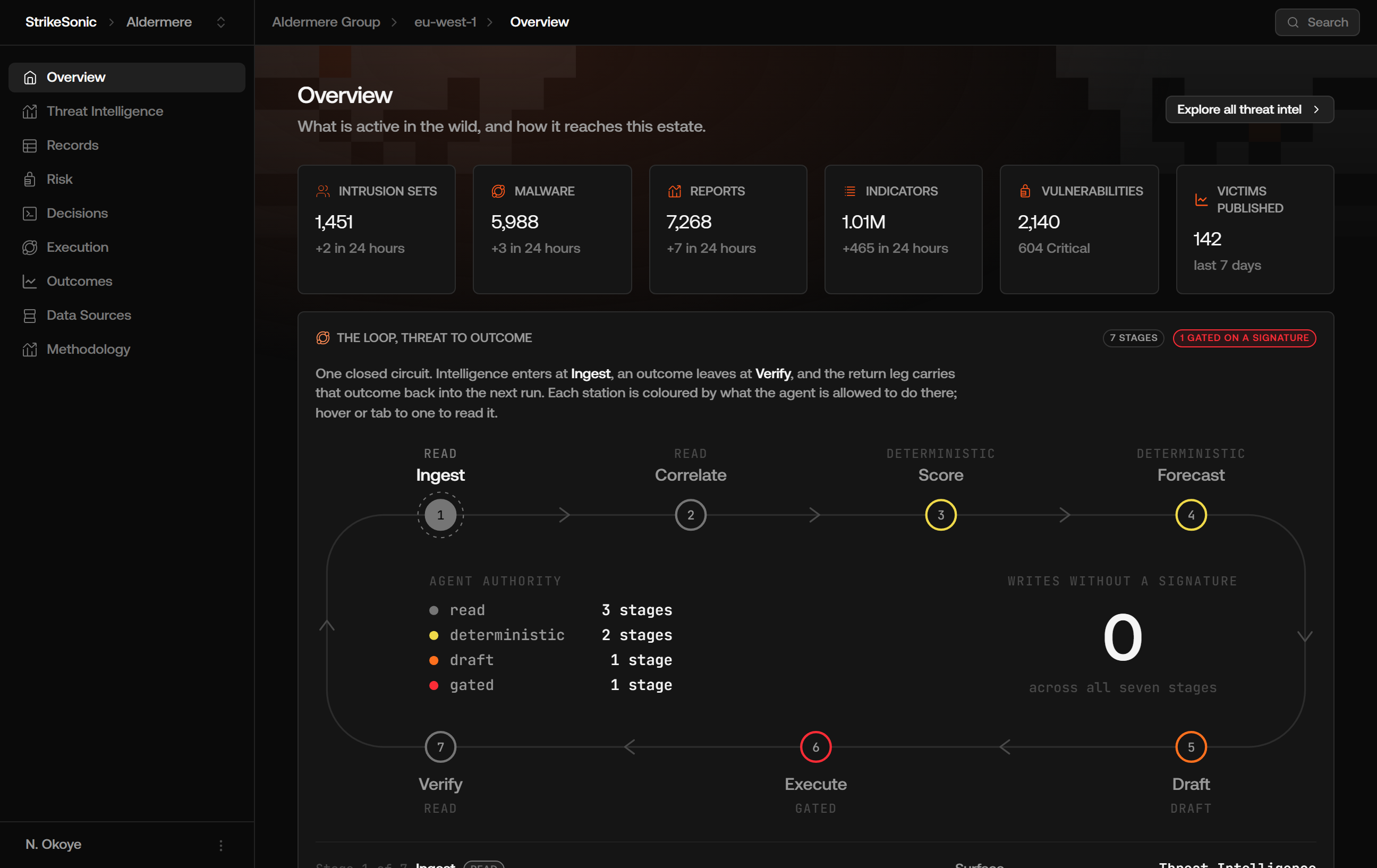
The loop
Threat to verified outcome, in eight stages
An agent runs every stage. A person owns the one that matters. Every stage writes to the same case file, so a finding, the decision it drove and the proof it worked stay one continuous story.
01 Observe
Agents read your scanners and the public feeds, and store what they found.
02 Understand
A vulnerability is matched to the assets that run it, and a case opens.
03 Assess
Findings rank by risk score, and each shows the multipliers behind it.
04 Decide
The agent drafts the call to take, its owner, and the evidence it cites.
05 Approve
Nothing changes until a named person signs that exact proposal.
06 Execute
Approved decisions are tracked through to the asset and the hour.
07 Measure
A rescan returns fixed, still vulnerable, or unverifiable. Never assumed.
08 Learn
Verified outcomes order the next run. They cannot change an urgency.
And back to 01
The next ingest carries the last outcome, so nothing is triaged twice.
Use cases
The questions a security team actually has to answer
Rank by what an exploit would actually reach.
Severity is one input of four, not the answer on its own.
Known-exploited findings carry the threat modifier. EPSS orders the work inside a band.
Entity resolution stops duplicate assets from double counting risk.
Why StrikeSonic
Most platforms stop at the list.
Detection tells you what is wrong. It does not decide, get a sign-off, make the change, or prove it worked. That half stays with your team, and it is the half StrikeSonic runs.
Without the loop
A prioritized list, and the real work starts after it
Severity ranking is not the same as business impact
A closed ticket is taken as proof the fix worked
AI that answers, with no record of what it read
With StrikeSonic
Eight stages from threat to verified outcome, in one case file
One published formula. Same inputs, same score, every run.
A rescan returns fixed, still vulnerable, or unverifiable
Every agent run cites the records behind it, under your tenant's row-level security
How it holds up
Rules built into the software, not into a policy document
One published formula
The agent explains and proposes. It never decides what is true. Scoring carries no learned weights, so the same inputs return the same number on every run.
Precision
One workflow, not seven dashboards
A problem has one continuous story. Every stage writes to the same case timeline, and there is nowhere else to write. Context moves between tiers as it ages, from a hot in-memory cache to SSD to archived evidence.

In memory -> SSD -> Object storage
Only measured results count
A rescan returns fixed, still vulnerable, or unverifiable. Only the first of those feeds learning, and the outcome is carried into the next investigation rather than re-derived.

Assets
Alerts
Decisions
There when your analysts are
Built to stay available, so the queue and the approval gate are there when your team is.
99.95% uptime
Agents
An agent at every stage, a signature before any change
The agent reads and drafts at every stage, and writes nowhere a person has not signed. It reads under your tenant's row-level security and cites what it read, so you check the reasoning rather than trust the verdict.
Every one has a single named owner.
One graph, and every agent reads it
One graph per tenant. Risk and Decisions read the same nodes, so a fact corrected once is corrected everywhere. There is only one place to change it.

Decisions, not alert queues
Every decision the agent drafts carries one owner and one of five categories: Escalate, Investigate, Accept Risk, Mitigate, Remediate.
Every agent shows its work
Every record carries its source, retrieval time and transform chain. Where a source is silent, StrikeSonic records the gap instead of filling it.
Lifecycle
Every transition is on the chain
Generated, reviewed, approved, executed, verified, closed. Every transition is appended to the hash-chained audit with its actor and timestamp.
The gate
Autonomy you can govern
The agents do the work. A person owns the consequence. Every proposal stops at a named approver, and the signature binds to that exact version of the recommendation.
 Tier 2 Analyst
 IR Lead
 Asset Owner
 Vulnerability Mgr
 Platform Owner
 Risk Reviewer
 Compliance Lead
One owner, one category, one state
Each decision names one accountable owner, one category out of Escalate, Investigate, Accept Risk, Mitigate or Remediate, and one lifecycle state. Nothing waits in the queue unowned.
Published bands, not opinions
Band boundaries are published, not tuned per account: 50, 20 and 5 on a 0.25 to 120 scale. Higher bands carry shorter review windows.
Risk crossed 50 on k8s-node-04. Owner set to IR Lead.
Approved by the Risk Reviewer. Execution owner notified.
Notified when a band changes
A notification is raised at the next scheduled re-score, when a decision crosses a band boundary or a review window lapses.
Total findings ingested
1.2 Billion
Decisions per month
1 Million
Scoring precision
99%
Trusted by
2k analysts
Guardrails
Built to be checked, not taken on trust
Prompt injection is first on the OWASP Top 10 for LLM applications, and the weakness is structural: a model cannot tell an instruction from data. StrikeSonic removes the path from injected text to an action.
Split across a trust boundary
A quarantined model reads untrusted text and holds no tools. The privileged model holds the tools and never sees that text.
Tamper-evident audit
Append-only and hash-chained: any edit breaks the chain, including edits made by StrikeSonic.
Tools on an allowlist
A defined set with strict schemas, local models first. The agent plans within bounds, and it cites or declines.
Pricing
Per-seat pricing that scales from a single analyst to the full enterprise.
Start free, upgrade as your graph grows.
Free
For exploring the public graph
€
Free forever
- 1 user
- Public intelligence graph
- Basic search
- 3 saved searches
- 3 threat actors
- 10 AI Copilot queries/month
- Public risk scoring
- Curated CTI feeds
Coming soon: No credit card required
Standard
For individual analysts
€
Save €78 per user
- 1 user
- Advanced filters
- 25 saved searches
- 5 watchlists
- 20 threat actors
- Single-lens Graph Explorer
- Full public evidence trail
- Read-only API
- Limited AI Workspace
- 500 AI Copilot queries/month
Coming soon: No credit card required
Pro
For teams running a private graph
€
Includes 5 seats. Save €598
- Private graph for 100 entities
- Multi-lens graph
- Risk Center
- Brand, domain, credential and dark-web monitoring
- 50 watchlists
- 250 saved searches
- Read/write API
- RBAC
- 30-day audit logs
- ITSM connector
- Webhooks
- 3,000 AI Copilot queries/month
Coming soon: Card required, cancel anytime
Enterprise
For organizations deploying at scale
Contact sales
Annual contract, priced to your estate
- Unlimited users and the full private graph
- Every connector, and cross-graph correlation
- Decision Center, risk simulation and the AI agent framework
- Workflow orchestration and regulatory intelligence
- SSO / SAML / OIDC, SCIM, governance controls and configurable audit retention
- Optional dedicated or on-prem infrastructure
- 99.95% SLA, 24/7 support and a dedicated CSM
Coming soon: Custom quote and onboarding
Frequently asked questions
StrikeSonic runs the whole loop, from threat to verified outcome. Most platforms stop at a prioritized list. StrikeSonic keeps going through deciding, sign-off, execution and proof. The difference starts at the score. Risk is one published formula, risk = base severity x asset criticality x exposure x threat modifier, so the same inputs always produce the same number. A worked case on prod-db-01 reads base 10 x criticality 2 x exposure 2 x threat 3 = 120, Critical Risk, confidence 99, Escalate. Most commercial platforms treat the score as proprietary.
It reads, correlates, scores and drafts. It changes nothing. Every proposal stops at a named approver, and the signature binds to that exact version of the recommendation. Execution re-verifies that signature before it raises a single change request, and it is the only part of the platform allowed to write to a system of yours.
Security teams that have more findings than they can act on, and need to defend the order they work in. Detection engineers, exposure management teams, the analysts who answer for what was left alone, and the approvers who sign for what was changed.
No. StrikeSonic is designed to sit alongside your SIEM and EDR rather than replace them. It has no scanner. It reads what they already collect and returns the decision layer they do not produce.
CISA KEV for confirmed active exploitation, NIST NVD for severity and affected versions, FIRST EPSS for exploitation likelihood, and Tenable.io for asset exposure and the verification rescan, all read-only. ServiceNow is the one system StrikeSonic writes to, and only under an approved decision. Asset inventories, identity providers, EDR and SIEM telemetry connect the same way.
Under a day for most teams. The public feeds need no credentials, so you can read a scored queue on your first afternoon. The write connector into your ITSM is a trust conversation before it is an engineering one, and we provide a forward-deployed engineer for enterprise pilots.
You pay per seat. Start free, move to Standard as an individual analyst, Pro once your team needs a private graph, and Enterprise when you need unlimited users, every connector and dedicated infrastructure. Enterprise is an annual contract priced to your estate rather than a list figure, so it is a conversation rather than a checkout.
Tenant isolation is enforced at seven layers, identically on every tier. Row-level security is forced, so even the table owner is filtered, and a cross-tenant test gates merges. Verified outcomes never cross a tenant boundary. We are SOC 2 and ISO 27001 certified, and dedicated or on-prem infrastructure is available on the Enterprise plan.
Close the loop
Every finding decided, signed, executed and proven.